 I know that one year of marriage is just a small step in the journey of lifelong love, but it still seems so significant! We celebrated fairly simply with a nice home-cooked meal and a re-watch of our wedding day video, but we are anticipating our upcoming vacation in the northern country where we will have time to really re-engage and properly celebrate one year of marriage!
Wednesday, July 20, 2011
One Year Anniversary!
I know that one year of marriage is just a small step in the journey of lifelong love, but it still seems so significant! We celebrated fairly simply with a nice home-cooked meal and a re-watch of our wedding day video, but we are anticipating our upcoming vacation in the northern country where we will have time to really re-engage and properly celebrate one year of marriage!


Go Cabin B!


One of the huge highlights of my summer was counseling senior high campers at Camp Quaker Haven in June. Abby Hutson and I had such an awesome cabin and we loved the girls in our cabin so much! I think the pictures attest to some of the incredible group bonding that took place!
Camp Quaker Haven - Guys Cabins!


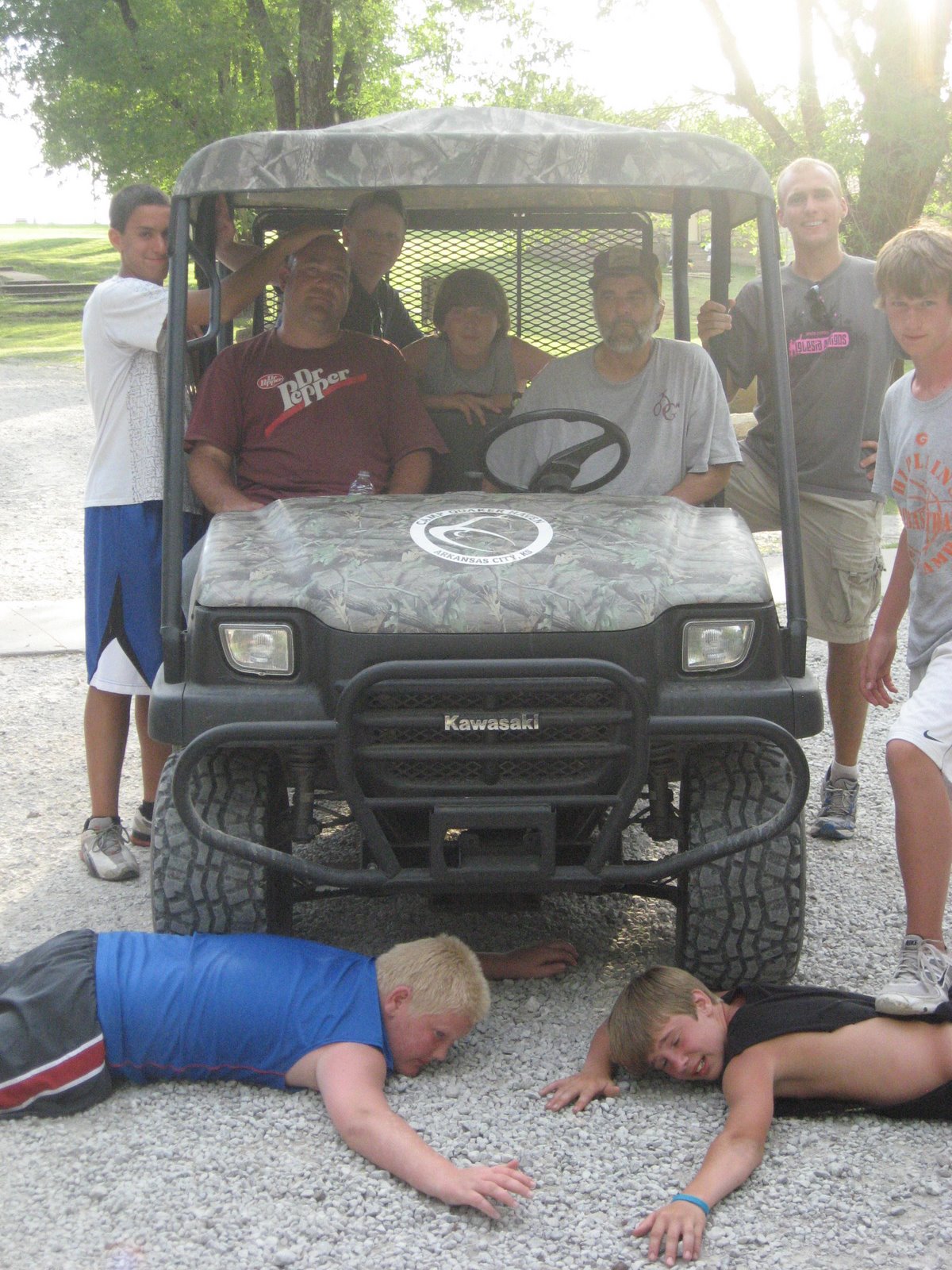
Adam counseled both senior and junior high camps this year at Camp Quaker Haven! I thought the very most awesome thing was that my little brother Caleb was able to fly out from New York to be in Adam's junior high camp cabin!
Tuesday, July 19, 2011
Progress!
Our house is still awaiting many little changes (and some big ones, like new windows), but progress is definitely being made and we are so excited! This week Hannah and Jacob came to work with us on our floors.
We redid all of the hardwood flooring and then put flooring in the dining room. We did some more demolition work and installed quarter-round throughout the whole house. It was quite an incredible task and I was so blessed to work with Hannah and Jacob - they actually made it quite fun!
Hopefully before too long we can put up more pictures that show even more progress! (Also, we have to show off Kenny Smith's custom kitchen, which is such a gift to us and maybe some pictures can be unveiled soon!)
We redid all of the hardwood flooring and then put flooring in the dining room. We did some more demolition work and installed quarter-round throughout the whole house. It was quite an incredible task and I was so blessed to work with Hannah and Jacob - they actually made it quite fun!
Hopefully before too long we can put up more pictures that show even more progress! (Also, we have to show off Kenny Smith's custom kitchen, which is such a gift to us and maybe some pictures can be unveiled soon!)
Get the flash player here: http://www.adobe.com/flashplayer
Saltshaker Sinaloa 2011
Get the flash player here: http://www.adobe.com/flashplayer
This summer has held many pretty big events for us - graduations in New York, camp counseling, housework, and a two week trip to Siete Ejidos, Mexico. It's been over a week since we've gotten back from Mexico, but I finally have a little window of time to sort through pictures.
Living in Mexico for two weeks was definitely an awesome new experience for me. When Adam and I were dating, I had once asked him (since his last name is Monaghan) if he was Irish. He said that he didn't know, but that he sure felt Mexican. Adam has always had a great love for the people of Mexico and has always wanted me to meet his Mexican family.
So this summer the two of us went to Siete Ejidos, Sinaloa with a team of people from different Friends churches in the mid-west. Siete Ejidos is a very small village surrounded by farm land where there is a small Friends Church. We simply lived among the people of this village for two weeks and ate with them, visited with them, experienced the roller coaster of life with them (hot, hot heat and then torrential rains), and just encouraged each other in our hope to live life more tangibly in the Kingdom of God.
I was amazed by the tremendous hospitality that was offered so generously to us during our visit. Adam and I both already miss our family in Siete Ejidos and hope that there will eventually be more opportunities to continue to build relationship with our friends there.
Lunar Trek 2011
I have always loved this race and still do. I participated in the first ever Lunar Trek in 2008 and finished the 40 miler. See Lunar Trek 2008 Report. I finished the 100K in 2009, the first time they offered that distance, on a year when a slight cool front rolled in around day break, providing a mid morning temperature of no more than low 80s and clouds. See Lunar Trek 2009 Report. I had to miss it in 2010 due to the date conflict. I was back in 2011, excited to finish the 100K again, a good long training run before next weekend’s Canadian Death Race in Northern Alberta, Canada and other fall races coming up.
Two of Sarah’s siblings were in town this week from New York, helping work on our house. Kind of at the last minute they all three decided to go with me up to Scandia, KS. We hit a bad thunderstorm near Concordia on the way. The clouds and storms were looking ominous before the start. When they got there they sat up a tent and, after I started running, they slept in the tent all night long, waking up just a few minutes before I finished the 40 miles.
Due to the thunderstorm and especially the lightning, the start was delayed about an hour and 20 minutes. When we first took off there was still plenty of awesome and scary lightning but it didn’t seem to be striking the ground anywhere close, mostly off to the east. I only heard one more rumble of thunder and felt a couple rain drops. Once the storm passed and winds died down, the stifling heat and humidity returned and the night was basically what was to be expected, with the exception of the mud. Yuck! About 6 of the 20 mile course was covered in mud, some of it with standing water and pretty gross.
My knees were really achy miles 5 – 15 and I didn’t like that but was running with a pack of people I know and was enjoying the talking and sharing stories. The legs felt better miles 25 – 35 than they did the first 25 which is weird but true. Mosquitoes were horrible in a couple places with no wind and standing water. I took the gravel and covered my legs with it to try to subside the itching. Didn’t really work. But some more rain that came in and running through the muddy standing water seemed to do the trick. We were running a solid 12 minute mile pace through 30. Around mile 30 I started feeling really nauseous. Couple times I thought I was going to through up. I think it was the mixture of the gels I was taking (approx 1 every 30-35 min) and the heat and who knows what else. I was running for the longest time with Laurie from Lawrence, who I’ve known through ultrarunning for several years now, and she had to stop for a couple minutes so I took the chance to walk one whole mile and down another gel and more water and electrolytes and within a few minutes I was feeling better. A mile or so down the road it was Laurie’s turn to feel awful and it took a while for that to go away. Eventually, we were both feeling fine or normal for the mileage but our pace had slowed a bit though was not terrible.
I decided not to carry a headlamp or a light of any kind because the other two years I carried one and never needed it/turned it on. Opps, that was dumb! I needed it a lot in the areas of mud, so I stuck close to people who had one, which was fine, but meant I needed to go their pace to be able to see. I’ll probably carry one again next year – and not use it.
Due to the delay of the start of the race by an hour and half, we got back to the school, with the end of 40 miles a little after 7:00 am which meant if I would have gone back out for the final 22 it would have taken 5+ hours and I would’ve finished afternoon or worse, in the heat. It was actually a pretty easy decision to stop at 40. Only 3 of the 15 starters finished the 100K. One of them is my friend Terry Rider and he finished around 3:00 pm and it was 106 degrees. (Terry is actually the only person in Lunar Trek history to finish all 3 100Ks!) I felt better and better about not going back out as I was riding back to Wichita, getting home before noon to take a nap!
I was pleased with the 40 miles and was only minimally sore the next day. I had fun running with my Lawrence Trailhawk friends and am excited for the upcoming fall races.
Lunar Trek race directors are incredibly friendly and hospitable and the whole thing is just one of my many favorites. I can’t wait to go back next year on Friday night, July, 27th and conquer the 100K once again. I might need someone to go with me and drive home… :)
Two of Sarah’s siblings were in town this week from New York, helping work on our house. Kind of at the last minute they all three decided to go with me up to Scandia, KS. We hit a bad thunderstorm near Concordia on the way. The clouds and storms were looking ominous before the start. When they got there they sat up a tent and, after I started running, they slept in the tent all night long, waking up just a few minutes before I finished the 40 miles.
Due to the thunderstorm and especially the lightning, the start was delayed about an hour and 20 minutes. When we first took off there was still plenty of awesome and scary lightning but it didn’t seem to be striking the ground anywhere close, mostly off to the east. I only heard one more rumble of thunder and felt a couple rain drops. Once the storm passed and winds died down, the stifling heat and humidity returned and the night was basically what was to be expected, with the exception of the mud. Yuck! About 6 of the 20 mile course was covered in mud, some of it with standing water and pretty gross.
My knees were really achy miles 5 – 15 and I didn’t like that but was running with a pack of people I know and was enjoying the talking and sharing stories. The legs felt better miles 25 – 35 than they did the first 25 which is weird but true. Mosquitoes were horrible in a couple places with no wind and standing water. I took the gravel and covered my legs with it to try to subside the itching. Didn’t really work. But some more rain that came in and running through the muddy standing water seemed to do the trick. We were running a solid 12 minute mile pace through 30. Around mile 30 I started feeling really nauseous. Couple times I thought I was going to through up. I think it was the mixture of the gels I was taking (approx 1 every 30-35 min) and the heat and who knows what else. I was running for the longest time with Laurie from Lawrence, who I’ve known through ultrarunning for several years now, and she had to stop for a couple minutes so I took the chance to walk one whole mile and down another gel and more water and electrolytes and within a few minutes I was feeling better. A mile or so down the road it was Laurie’s turn to feel awful and it took a while for that to go away. Eventually, we were both feeling fine or normal for the mileage but our pace had slowed a bit though was not terrible.
I decided not to carry a headlamp or a light of any kind because the other two years I carried one and never needed it/turned it on. Opps, that was dumb! I needed it a lot in the areas of mud, so I stuck close to people who had one, which was fine, but meant I needed to go their pace to be able to see. I’ll probably carry one again next year – and not use it.
Due to the delay of the start of the race by an hour and half, we got back to the school, with the end of 40 miles a little after 7:00 am which meant if I would have gone back out for the final 22 it would have taken 5+ hours and I would’ve finished afternoon or worse, in the heat. It was actually a pretty easy decision to stop at 40. Only 3 of the 15 starters finished the 100K. One of them is my friend Terry Rider and he finished around 3:00 pm and it was 106 degrees. (Terry is actually the only person in Lunar Trek history to finish all 3 100Ks!) I felt better and better about not going back out as I was riding back to Wichita, getting home before noon to take a nap!
I was pleased with the 40 miles and was only minimally sore the next day. I had fun running with my Lawrence Trailhawk friends and am excited for the upcoming fall races.
Lunar Trek race directors are incredibly friendly and hospitable and the whole thing is just one of my many favorites. I can’t wait to go back next year on Friday night, July, 27th and conquer the 100K once again. I might need someone to go with me and drive home… :)
Tuesday, June 21, 2011
Right Here Right Now
Right Here Right Now: Everyday Mission for Everyday People
By Alan Hirsch & Lance Ford

Church is not simply a building or a formal community meeting, it is who we are—a people who have been formed out of a direct encounter with God in Jesus Christ. If this is true, then general practice in church planting, which simply amounts to “service planting,” actually activates only once side of the movement equation—namely, apostolic mission—but it leaves the MPOG (Mission of the People of God) undervalued and almost totally passive and unengaged. This is a fatal error. 33
Embodiment (the capacity to actually integrate and live out the teachings and message of Jesus) is critical to transmission (the capacity to transfer the message through relationships). 34
In order to take missionality seriously, you have to take culture seriously…You simply have to assume that, in Western contexts, all communication of the gospel, let alone church planting and mission, is now cross-cultural. 39
One of the most basic assumptions of the incarnational missionary is to assume God is already involved in every person’s life and is calling them to himself through his Son. Out mindset should not be the prevalent one of taking God with us wherever we go. It must be, instead, that we join God in his mission. 42
We live as if there is an insurmountable difference between the “sacred” and the “secular.” But if Jesus is Lord of all life, there is no such distinction. 47
Just like a local gang, we should have a “turf”…You should live where you want to serve. You should be able to bump into the tribe in the local shops and supermarket. This allows for what I call three practices of incarnational engagement: proximity, frequency, and spontaneity. 49-50
It is impossible to be a missional church if we fail to be a missional people. Otherwise, missionality is reduced to sponsored programs that centralize the life of the body of Christ, institutionalizing and containing it in church systems and programs that view mission as something that happens “over there” or at special events. 65
The reality of our situation is that Christendom has been in decline for the last 250 years. This is what the term post-Christendom means. Society…is “over” Christendom. The problem for man Christians and church leaders is that we have not come to grips with this fact. We fight for prayers and the Ten Commandments…because we think Christianity is the dominant civil religion and ought to be so. In other words, we still think of the church and its mission in terms of Christendom, while in reality we are in a post-Christendom context. 74
When I hear someone say, “Five people gave their lives to the Lord in our meeting last night,” I bristle. I want to ask, “How do you know they gave their lives to the Lord?” You can’t know that until some degree of time goes by. 77
Use your heads as you live and work among outsiders. Don’t miss a trick. Make the most of every opportunity. Be gracious in your speech. The goal is to bring out the best in others in a conversation, not put them down, not cut them out. Colossians 4:5-6, Message
John Wimber was known for holding a Bible up and saying, “This is the menu, folks…it ain’t the meal.”…When we mix the Word of God with real feet-to-the-pavement living, we can experience a kingdom feast every day and invite others to join us at that table. Until we let that happen, the words of the Bible remain as dormant as garden seeds left in their original envelope. The words just languish as possibilities, ideas, and options. 102 Again, the menu isn’t the meal. Studyin the menu will not provide nourishment nor curb hunger. 117
The pursuit of happiness has left a trail of tears on many fronts. 127
For too long, church culture has steamed down the channel of self-centeredness and away from community building and societal transformation. We need a radical reformation of leadership that preaches, models, and leads with a message that stirs us away from the trending ascendance of personal ambition. 129
When at all costs we hold the nuclear family and middle-class concepts at the pinnacle of our priorities, we become dull and blind to the injustices around us. Family ideals and the American Dream hold loyalty over and above the initiative of the kingdom of God and the justice and mercy it calls for. The presumptive “if you believe it, you can become it” notion causes many in the middle class to dismiss their obligation to those who are homeless or to interpret the plight of the poor as reaping a harvest from their own lazy lack of initiative. That is, at least, until the middle class themselves become the unemployed as has occurred in the recent economic crash—then it’s someone else’s fault. 132
Individualism and our desire for comfort and privacy choke out the Word and our missional imagination along with it, nullifying our effectiveness as agents of the kingdom of God. 132
We must make up our minds that we will disentangle ourselves from the suffocating weight that comes with living and overly consumptive lifestyle. We make a choice to break free in order to live redemptively. 144
We need both a radically lean way of living by some disciples and an elaborate abundance shared by others…We need people who are called to a radical simplicity of lifestyle, to remind the rest of us that we don’t need what we think…We need communities of Christians willing to commit themselves to support each other in risky, venturesome ways, to goad the rest of us out of our autonomy. We need Christians willing to resist the many ways in which the dominant in our world crush the weak. We need Christians who find thousand joyful ways to take the screwed-up values of this world and turn them upside down. 147
For authentic community to marinate, we need a mix of people with various skills and interests coming together and rubbing off on one another. Silo living breeds social disintegration. It fosters a life that segregates our relationships with others and limits intermingling among the people in our differing silos. 164
A sanctified imagination is a powerful missional tool. 191
Shared adventures are like glue to relationships, and there really is adventure to be had, if we will open our eyes and ears to see the needs right under our noses. 193
People should be able to experience a foretaste of heaven from our families and our homes…Missional hospitality is a tremendous opportunity to extend the kingdom of God. We can literally eat our way into the kingdom of God. 203
Too often, the largest portions of our time, resources, finances, and manpower go into one basket—weekend services…In short, our actions say that what we do inside the building is more important than what we do outside the building. 217
.
Contrary to what we might think, Jesus shows us that meeting needs is not the starting point for incarnational mission. 225
Truth is, we have all drunk so deeply from the institutional wells of Christianity that it is hard to think of ourselves differently. 236
We certainly need to think of the church more as an exponential people movement involving all of God’s people and not an institution run by religious professionals offering different brands of religious goods and services. 238
The traditional marks of the church that stemmed from the reformation are woefully inadequate to equip the contemporary Western church to deal with the bewildering missionary challenge we face. 239
We are all deeply scripted to believe that we must bring people to our church, and so we seldom take into account the cultural dynamics inherent in that equation. But it’s all about culture. Our church has a distinct culture, as do the people we are hoping to reach! …all mission in Western settings now should be considered a cross-cultural enterprise. 251
Attractional evangelism in missionary contexts results in extracting them from their previous relationships and cultural context. 251
Attractional forms of church in missionary contexts eventually are self-defeating because the church quickly exhausts its suppy of relationships and because the new converts quickly become a cultural clique or religious ghetto increasingly marginalized from the original culture. 252
Planting Missional Churches

I read Planting Missional Churches way back in February – actually on the plane on the way to and from Bangladesh. It’s 372 pages and I have never read a book of that length in literally two sittings. It is an excellent expose on church planting as a whole by one of the church planting godfather gurus. I recommend this book as a basic primer for church planting, though I might add others to that same list as ‘required reading’ for church planting, maybe even a little bit higher up on the list. The funny thing is how fast things change in culture and church culture to be specific, though, in a lot of contexts you wouldn’t know it. This book was written in 2006 and the trends are already changing so much.
The one biggest thing I take a way from Planting Missional Churches is the call for church planting to take a missiological posture. I believe this is what is missing from most attempts at ‘outreach’ – an ignorance or obliviousness to the context. Just like we would do on the “to the ends of the earth” mission fields, like learning the language, culture, customs, etc., we must have a posture of entering into a culture and speaking the language to allow our message to be truly understood and embraced. This books help to not only establish the need for contextualization but helps to set the stage for emerging culture 101 of North America.
Some of my favorite quotes from the text:
Establishing a missional church means that you plant a church that’s part of the culture you’re seeking to reach. 1
Today’s church planters should be: missional, incarnational, theological, ecclesiological, and spiritual. 3
Church planters are by nature entrepreneurs, mavericks, free spirits, sometimes even misfits… 3
In 2004, the latest year available, there are 11 churches for every 10,000 Americans. 9
With the increased professionalization (education) of the clergy, church planting has suffered. 9
The U.S. is the fifth largest mission field on earth. 13
Eighty to 85 percent of American churches are on the downside of their life cycle. 13
Our churches are dying, and our culture is changing. We know new churches can make a difference. Church planting is not easy, but without it the church will continue to decline in North America. 14
The end of Christendom allows the church to recognize that the gospel is distinct from Western culture. So the gospel must be addressed in fresh ways to the ever-changing population that’s disassociated itself from the “pseudo-Christian” roots…The new challenge is to bring the gospel to Western culture, including right here in North America, since it’s become so resistant to the gospel. 19
High content (being biblically sound) and high culture (being culturally relevant) aren’t mutually exclusive. 21
If anything, the church should err on the side of becoming futurists (rather than historians) in regard to culture. 23
The reformers expressed that as eccelsia simper reformada, the church always reforming. It would never arrive. That remains true today. As the culture changes, the church is compelled to change. 31
Biblical Basis of Church Planting: John 20:21; Luke 19:10; Matthew 28:18-20; Luke 24:47; Acts 1:8; 1 Corinthians 1:23. 37-52
Churches need biblical eccesiology that enables them to function with efficiency and integrity. 90
Effective church planting is missionary work. 115
A key to ministry in the new era will be the creation of multiethnic faith communities that reflect the demographic makeup of their population. 123
Understanding postmodernity: denial of personal objectivity, uncertainty of knowledge, death of any all-inclusive explanation, the denial of the inherent goodness of knowledge, the rejection of progress, the surpremacy of community-based knowledge, and the disbelief in objective inquiry. 130
Church planters…embracing church planting as a way of life rather than a strategy…Rather than starting with a prescribed vision of what the church will look like (most good church planters spell this out in a vision prospectus or fund-raising proposal), proponents of this new way of planting churches (Missional/Incarnational) let their incarnation of Christ drive the mission in their community and beyond; and the church emerges out of that journey. 161
If church planting is missionary work, then the church planters and the planting team should think like missionaries in planning worship music. Leaders should choose the music based on the context. Music should be missiological (“like a missionary”) and serviceable in the context. 266
Saturday, June 4, 2011
Gilead, Marilynne Robinson
I haven't loved a book in quite some time as much as I loved Gilead, a Pulitzer-winning book written by Marilynne Robinson. It is the reflection of an elderly and dying father and small town preacher, written to a young son borne to him in his old age. He records the stories and insights that he would have shared with his son if he had been given the opportunity to know his son in his adulthood. The art of the book is outstanding and the tidbits of wisdom scattered through his stories are quite powerful. Some of these are shared below. - Sarah
"I believe the Fifth Commandment belongs in the first tablet, among the laws that describe right worship, because right worship is right perception, and here the Scripture commands right perception of people you have a real and deep knowledge of."
"The article is called "God and the American People," and it says 95% of us say we believe in God. But our religion doesn't meet the writer's standards, not at all. To his mind, all those people in all those churches are the scribes and the Pharisees. He seems to me to be a bit of a scribe himself, scorning and rebuking the way he does. How do you tell a scribe from a prophet, which is what he clearly takes himself to be? The prophets love the people they chastise, a thing this writer does not appear to me to do."
"There are certain attributes our faith assigns to God: omniscience, omnipotence, justice and grace. We human beings have such a slight acquaintance with power and knowledge, so little conception of justice and so slight a capacity for grace, that the workings of these great attributes together is a mystery we cannot hope to penetrate."
"I have often felt that my failing the truth could have no bearing at all on the Truth itself, which could never conceivably be in any sense dependent on me or on anyone."
"I have had a certain amount of experience with skepticism and the conversation it generates, and there is an inevitable futility in it. It is even destructive. Young people from my own flock have come home with a copy of La Nausee or L'Immoraliste, flummoxed by the possibility of unbelief, when I must have told them a thousand times that unbelief is possible. And they are attracted to it by the very books that tell them what a misery it is. And they want me to defend religion, and they want me to give them "proofs." I just won't do it. It only confirms them in their skepticism. Because nothing true can be said about God from a posture of defense."
"There is no justice in love, no proportion in it, and there need not be, because in any specific instance it is only a glimpse or parable of an embracing, incomprehensible reality. It makes no sense at all because it is the eternal breaking in on the temporal."
"Theologians talk about a prevenient grace that precedes grace itself and allows us to accept it. I think there must also be a prevenient courage that allows us to be brave - that is, to acknowledge that there is more beauty than our eyes can bear, that precious things have been put into our hands and to do nothing to honor them is great harm. And therefore, this courage allows us, as the old men said, to make ourselves useful."
"I believe that the old man did indeed have far too narrow an idea of what a vision might be. He may, so to speak, have been too dazzled by the great light of his experience to realize that an impressive sun shines on us all. Sometimes the visionary aspect of any particular day comes to you in the memory of it, or it opens to you over time. I believe there are visions that come to us only in memory, in retrospect."
Friday, June 3, 2011


Subscribe to:
Posts (Atom)